
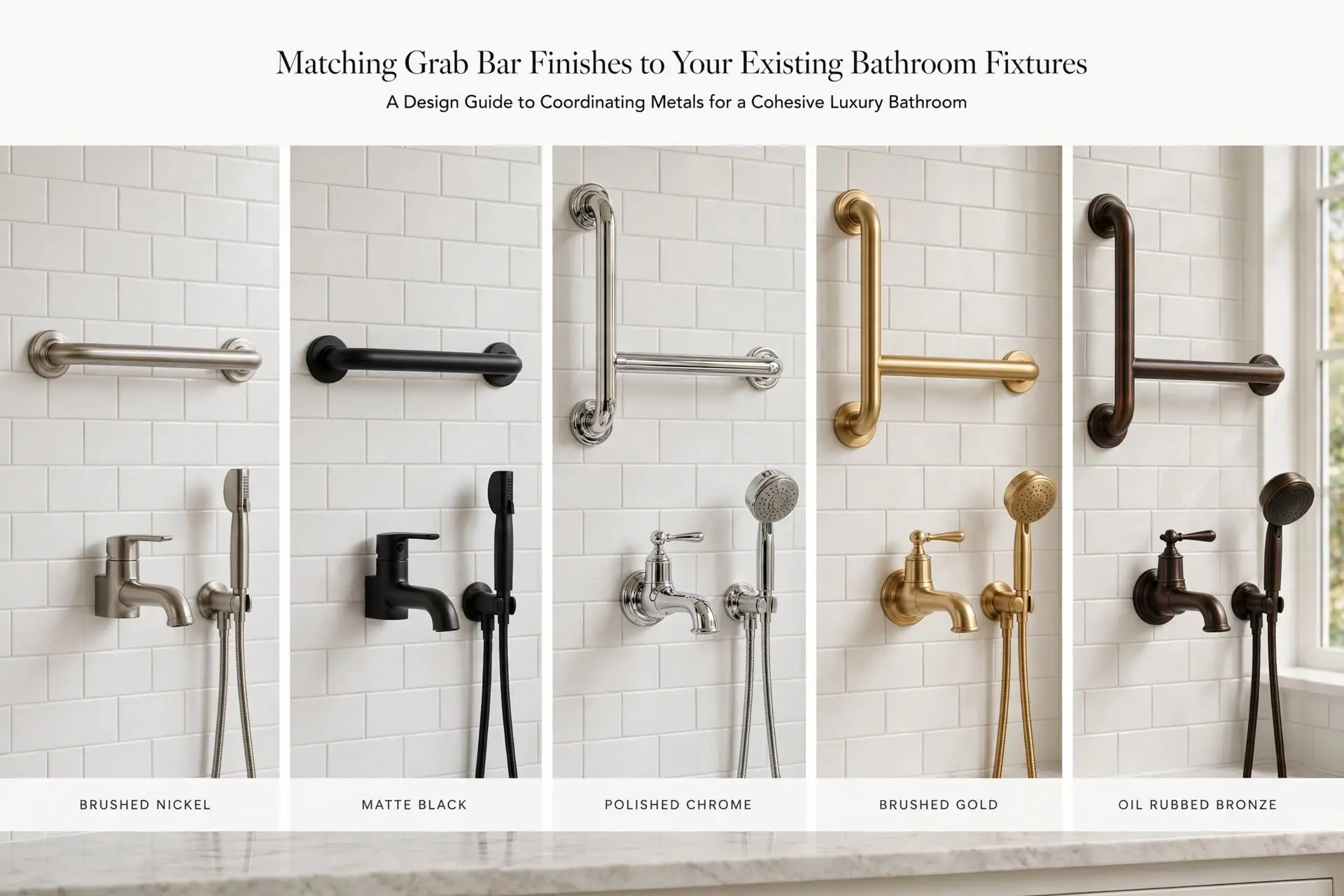
The first grab bars that showed up in American bathrooms were the chrome hospital-style bars that everyone associates with a nursing home. They worked, but they looked out of place in a home bathroom, and a lot of seniors resisted installing them for that reason alone. The finish options have gotten much better over the last decade. A well-chosen grab bar now looks like a piece of the bathroom hardware rather than a piece of medical equipment. This is a practical guide to matching grab bar finishes to the fixtures you already have.
Why Finish Matching Matters
There are two reasons that finish matching matters more than most people expect.
The first is that a grab bar that matches the existing fixtures becomes visually invisible. A senior who is self-conscious about aging equipment in their bathroom is more likely to use bars that look like they were always meant to be there. That psychological piece affects daily behavior in a way that is easy to underestimate.
The second is resale value. A bathroom with mismatched hardware looks like a house that has been patched together over time. A bathroom with matched finishes looks like a coordinated space, which affects buyer perception when the home eventually sells. For a homeowner planning to age in place for many years, this matters less. For a homeowner planning to sell within five to ten years, matching finishes protect the value of the bathroom.
The Main Finish Categories
Grab bars come in a range of finishes that mirror the finish options for other bathroom hardware. Matching within a category is more important than matching the exact shade.
Polished Chrome
Polished chrome is the classic bathroom finish and still the most common in American homes built before 2010. It has a bright, mirror-like surface and pairs with white porcelain and clean tile work.
If the existing faucets, showerhead, towel bars, and toilet paper holder are polished chrome, the grab bars should be too. Polished chrome grab bars are widely available from every major manufacturer and are usually the least expensive finish option, running $30 to $80 per bar for the equipment alone.
Brushed Nickel
Brushed nickel became popular in the late 1990s and dominated new bathroom construction for about 15 years. It has a soft, matte silver appearance that hides water spots and fingerprints better than polished chrome.
Brushed nickel grab bars pair well with brushed nickel faucets, cabinet pulls, and light fixtures. The finish is warm enough to work in bathrooms with beige, cream, or warm gray tile, and it does not compete with wood cabinetry the way polished chrome sometimes does. Cost is similar to polished chrome, at $30 to $80 per bar.
Oil-Rubbed Bronze
Oil-rubbed bronze had a strong run in the mid-2000s and remains popular in traditional and craftsman-style bathrooms across East King County. It has a dark brown-black finish with reddish undertones and pairs with warm-toned tile, wood, and stone.
Grab bars in oil-rubbed bronze are widely available but cost slightly more than chrome or brushed nickel, running $50 to $120 per bar. The finish is more durable than it looks and holds up well in wet bathroom environments.
Matte Black
Matte black has taken over new bathroom construction in the last five years. Almost every high-end remodel done in Bellevue and Kirkland since 2020 uses matte black hardware. The finish is bold, modern, and pairs with white subway tile, gray porcelain, and light wood vanities.
Matte black grab bars are now available from most manufacturers and cost about the same as oil-rubbed bronze, at $50 to $150 per bar. The finish shows dust and hard water more than chrome or nickel, so it needs slightly more frequent cleaning to keep looking sharp.
Brushed Gold & Champagne Bronze
The warm metals have made a comeback in recent design trends. Brushed gold and champagne bronze finishes appear in higher-end remodels and pair with white marble, warm wood, and off-white walls.
Grab bars in these finishes are less commonly available and cost more, running $80 to $200 per bar. For a bathroom where the rest of the hardware is brushed gold, the extra cost of matching bars is usually worth it. For a bathroom where only the vanity faucet is brushed gold, chrome or brushed nickel bars often look better than trying to force a match.
How to Match Without Overthinking It
The rule that works for most bathrooms is to match the grab bar finish to the finish that appears most often in the room. In most bathrooms, that is either the shower fixtures or the vanity fixtures.
Look at the shower faucet trim, the showerhead, and the shower door hardware. Then look at the vanity faucet, the cabinet pulls, and the towel bars. Whatever finish shows up in the majority of those items is the finish the grab bars should match.
When the Bathroom Has Mixed Finishes
Some bathrooms have deliberately mixed finishes as part of the design. A bathroom might have chrome plumbing fixtures with brushed nickel cabinet hardware, or matte black faucets with polished nickel light fixtures. In these bathrooms, the grab bars should match the plumbing fixtures rather than the accessories, because the bars are functionally closest to the plumbing category.
When None of the Finishes Work
If the existing bathroom has old, worn hardware in a finish that no longer looks good, the grab bar install becomes a small opportunity to start a broader hardware refresh. Swapping the towel bars, toilet paper holder, and cabinet pulls at the same time costs $200 to $500 for the materials, plus a few hours of labor. The bathroom ends up looking coordinated and updated, and the grab bars go in as part of a matched set rather than as a lone piece of new hardware in a tired room.
What to Buy & Where
Major manufacturers such as Moen, Delta, and Kohler make grab bars in most finish options, and their bars are widely available at home improvement stores and plumbing supply houses in the Bellevue and Kirkland area. For less common finishes, specialty online retailers such as Grabcessories, Invisia, and Great Grabz carry a wider selection.
A good installer will bring finish samples to the initial visit and let the homeowner hold each option up next to the existing hardware before ordering. That five-minute step avoids the frustration of ordering a finish that looked right in a photo but reads differently in the actual room. The bars themselves should always be rated for at least 250 pounds of load, and the manufacturer should provide a warranty covering the finish for at least ten years.