
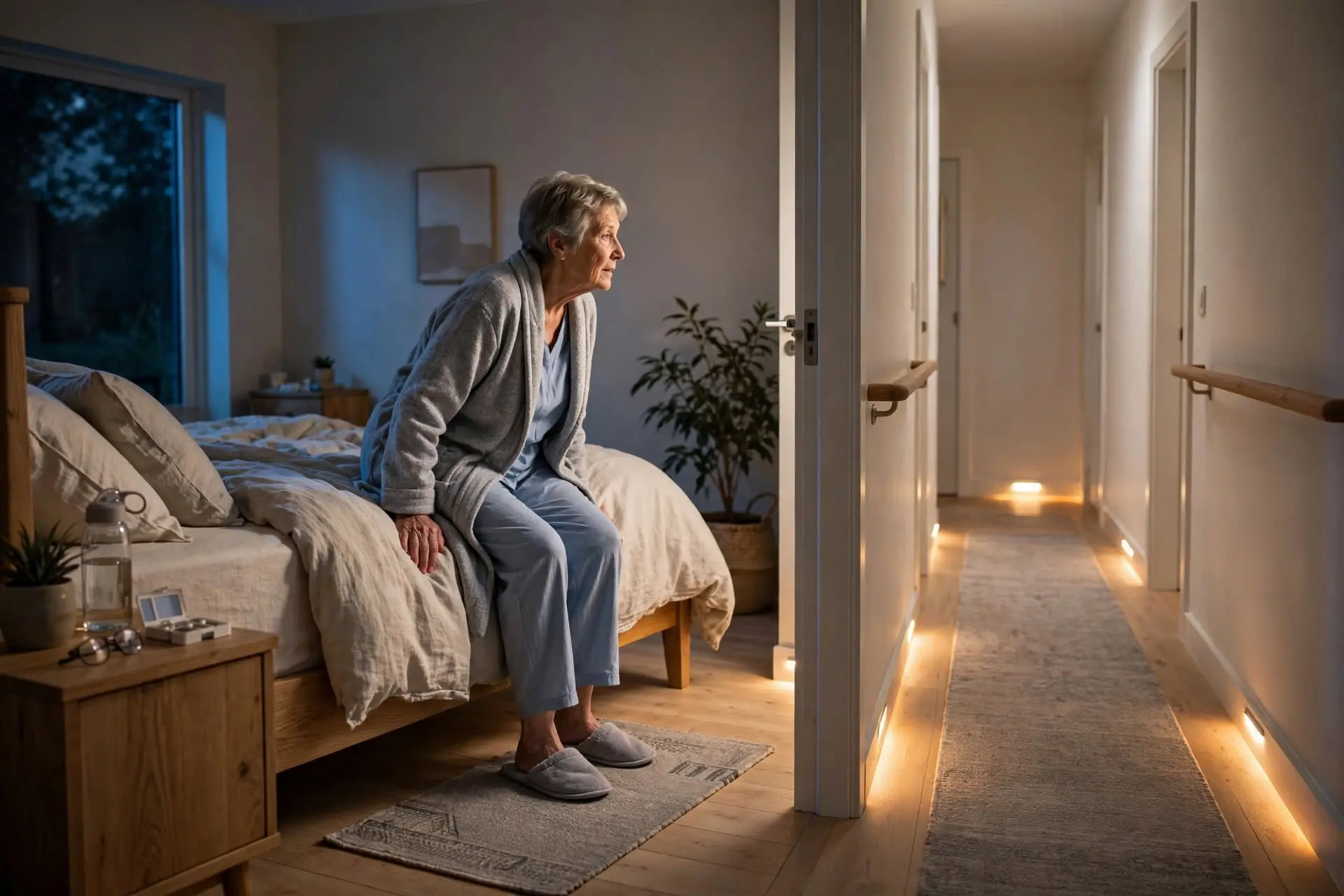
The most dangerous walk in a senior’s day is often the shortest one. It is the trip from the bed to the bathroom at 2 a.m. Nobody is fully awake for it. The lights are usually off. The eyes have been adjusted to darkness for hours. And the whole thing happens on autopilot, with the body moving before the mind has caught up. Almost every senior in the Bellevue and Kirkland area who has had a nighttime fall was doing this walk when it happened. The good news is that the bedroom and hallway can be set up in a way that removes most of the risk without changing how the room looks during the day.
Why Night Falls Happen
Three things line up to make nighttime falls more common than daytime falls.
The first is medication timing. Many seniors take medications in the evening that peak in the middle of the night, including blood pressure drugs that cause postural hypotension when the person stands up quickly, and sleep aids that impair balance and coordination for hours after taking them.
The second is dehydration and full bladder pressure. Most seniors wake up between midnight and 4 a.m. with a real physical need to reach the bathroom quickly. That urgency causes them to move faster than they would during the day, with less time to catch a stumble or notice an obstacle.
The third is vision. Even a healthy eye takes 20 to 30 minutes to fully adjust to darkness, and that adjustment reverses in seconds if a bright light comes on. A senior walking through a dark bedroom cannot see obstacles clearly. A senior who turns on a bright overhead light suffers a temporary depth perception issue that lasts several seconds after the light comes on.
The Bed Itself
The bed is the starting point for the nighttime walk, and how it is set up affects everything that happens next.
Height & Firmness
The mattress top should sit 20 to 23 inches off the floor for most seniors. That range lets the person sit down and stand up without straining. A bed that is too low forces the person to drop down and then push up against gravity, which is hard on the knees and hips at any hour but especially at 2 a.m. when the muscles are cold and stiff.
If the current bed is too low, bed risers under the legs raise it by 3 to 5 inches for about $20. If the bed is too high, either a lower box spring or removing the frame temporarily brings it down.
Bed Rails & Assist Bars
For seniors who need help getting up and down, a bed assist bar that attaches to the bed frame gives something solid to grab during the transition. The bar sits at the side of the mattress and provides support for pushing up to sitting and for lowering back down. Cost is $50 to $150. Some models double as a rail that keeps the person from rolling out of bed, which matters for seniors with reduced mobility.
Full-length bed rails, the kind used in hospitals, are usually not the right choice for a home bedroom. They pose entrapment risks and can create a false sense of security. A partial assist bar at the head end of the bed does the useful job without the downsides.
Lighting the Path
Lighting is the single most impactful change that can be made for nighttime bedroom and hallway safety.
Motion-Sensor Night Lights
Small motion-sensor night lights plugged in low on the wall between the bed and the bathroom door give the person a lit path without any effort. When the person swings their legs over the edge of the bed, the light comes on. The person walks to the bathroom in soft light and does not need to touch a switch.
The lights should be rated at 5 to 15 lumens for nighttime use. That is bright enough to see the floor and any obstacles, but not bright enough to wake the person up fully or to cause pupil constriction that reverses the dark adaptation. Cost is $10 to $25 per light. Most bedroom-to-bathroom paths need two to three lights to cover the full walk.
Bathroom Lighting
Inside the bathroom itself, a small motion-sensor light or a night light near the toilet gives enough visibility for the actual bathroom trip without needing to turn on the overhead light. Some seniors keep a small light on continuously in the bathroom overnight, which works well as long as the light is dim enough not to disturb sleep from across the hallway.
Avoiding Bright Overhead Lights
The instinct for most people is to turn on the main overhead light when getting up at night. For a senior, this is one of the worst habits from a fall-risk perspective. The bright light causes several seconds of poor depth perception right at the moment the person is starting to walk. Motion-sensor low-lumen lights avoid this problem entirely by providing enough light to see without any of the pupil shock.
The Hallway
The hallway between the bedroom and the bathroom needs a few specific things to be safe at night.
Clear Path
The hallway should have nothing on the floor. No throw rugs. No pet beds. No laundry baskets. No shoes. Anything on the floor of a hallway is a trip hazard for anyone walking through it in low light with sleepy feet.
Handrail Support
For longer hallways or for seniors who feel unsteady walking, a wall-mounted handrail along one side of the hallway gives something to hold onto. The rail should mount at 34 to 38 inches off the floor, into wall studs or with rated heavy-duty anchors. Cost for a hallway rail install is $200 to $500 depending on the length and the wall construction.
The Bathroom Setup for Nighttime
The bathroom is the destination of the nighttime walk, and how it is set up matters for the return trip as well as the arrival.
A grab bar at the toilet gives support for standing up in the middle of the night when balance is at its worst. A comfort-height toilet at 17 to 19 inches off the floor removes the strain of standing up from a standard 14 to 15 inch toilet.
The floor should have anti-slip treatment or a well-secured non-slip mat. Wet floors in low light are one of the highest-risk conditions in the home, and the treatment or mat gives the foot something to grip on the way in and out.
Making the Changes Tonight
Almost every change on this list can be made in a single evening with a trip to the hardware store. Motion-sensor lights, bed risers, and a bed assist bar can be installed by anyone in the household in under an hour. The grab bar work and handrail installation require a professional installer for proper anchoring, but the smaller changes make an immediate difference on their own. The nighttime walk to the bathroom can go from the most dangerous part of the day to one of the safest, and the change usually happens within the first week.