
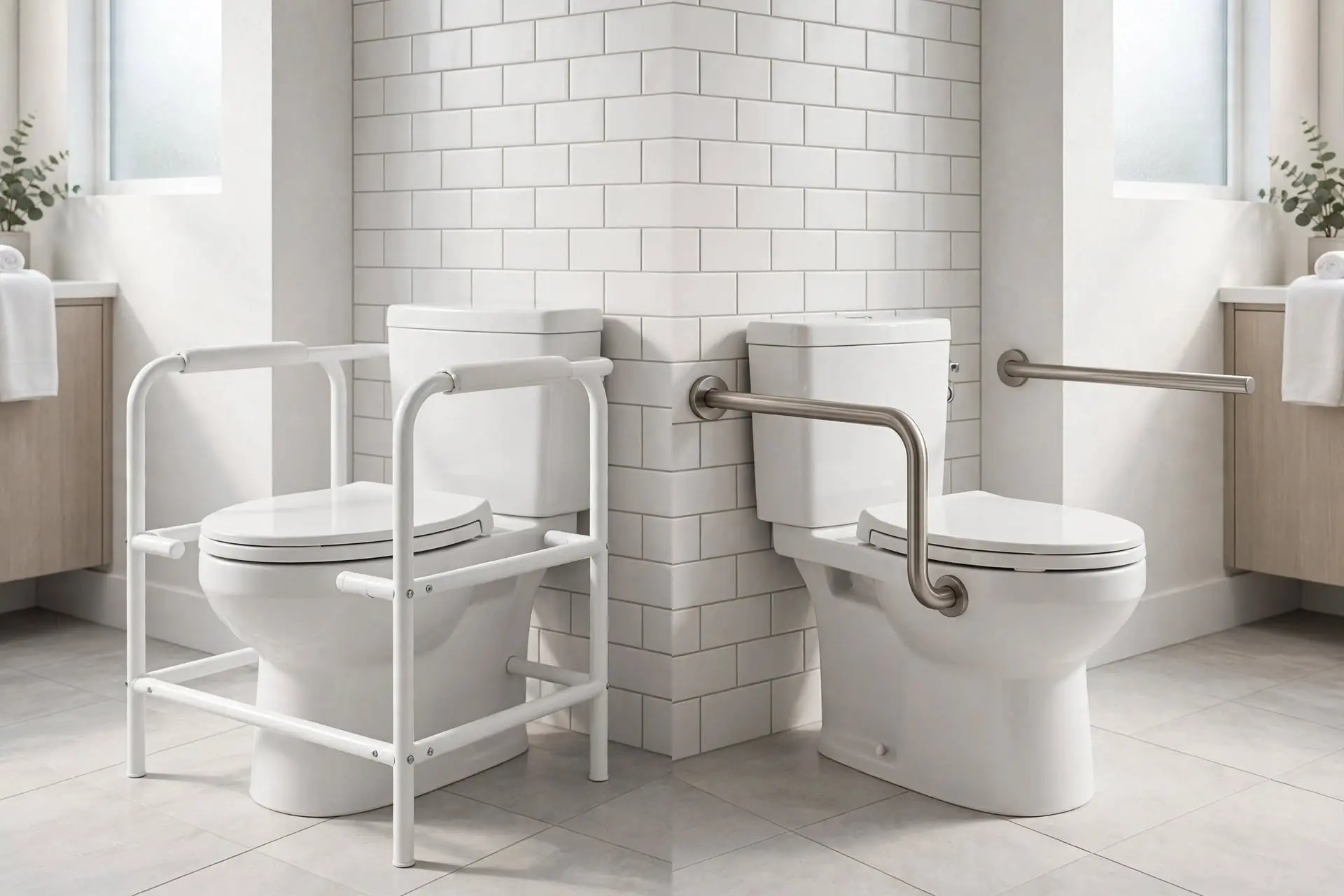
Anyone shopping for toilet safety equipment runs into the same two products right away. One is a toilet safety frame that stands on the floor and clamps to the toilet itself. The other is a wall-mounted grab bar that anchors into the studs behind the wall. Both promise to help a senior stand up from the toilet more safely. Both cost about the same range of money. But they are not interchangeable, and picking the wrong one for the situation leads to either a piece of equipment that does not get used or a piece of equipment that gives false confidence in a real fall. This is a practical breakdown of which one fits which household.
What a Toilet Safety Frame Is
A toilet safety frame is a freestanding metal frame that goes around the toilet. Two vertical posts stand on the floor on either side of the toilet, connected to a horizontal bar across the back that clamps under the toilet seat bolts. The user pushes up with both hands on the side arms to stand up, and lowers themselves down with the same support on the way down.
The whole unit installs in about ten minutes without any drilling. Loosen the seat bolts, slip the frame’s back bar under them, tighten the bolts back down, and adjust the height of the arms. The frame comes off just as quickly if the household ever needs to remove it.
Cost is $40 to $150 depending on the model. Higher-end frames have adjustable arm height, padded grips, and better stability at the base.
Where a Frame Works Well
Toilet safety frames are the right answer in several specific situations.
Rental units where drilling into walls is restricted or requires landlord approval are one of the most common cases. The frame provides real support without touching the walls, and it comes off cleanly at move-out.
Short-term recovery is another good fit. A senior coming home after hip surgery, knee surgery, or an extended hospital stay often needs bilateral toilet support for a few weeks, then returns to a mobility level where a single wall bar is enough. The safety frame fills that recovery window without a permanent install.
Bathrooms where the toilet sits far from any wall are a third case. Some toilets, particularly in older or unusual layouts, sit in the middle of a wall or in a corner where a wall-mounted bar cannot be placed on both sides. A freestanding frame provides support from both sides without any wall dependence.
What a Wall-Mounted Grab Bar Is
A wall-mounted grab bar is a stainless steel or aluminum bar anchored into the wall studs behind the tile or drywall. For a toilet, the standard placement is a vertical or angled bar on the wall closest to the user, mounted 33 to 36 inches above the floor. The bar sticks out from the wall about three inches, giving the user a solid handle to pull against for standing up.
Installation takes 30 to 45 minutes per bar. The installer locates the wall studs, drills through the tile or drywall, and anchors the bar with heavy-duty screws directly into the framing. When properly installed, a good grab bar is rated to hold 250 to 500 pounds of load, which covers the full body weight of almost any user under real fall conditions.
Cost is $150 to $250 per bar installed, including the bar itself and the labor.
Where a Wall Bar Works Well
Wall-mounted grab bars are the right answer for most permanent household installations where the toilet sits next to a wall with wood or metal studs behind it.
The permanent nature of the install matters. A senior who lives in the house long-term gets a bar that never shifts, never needs adjustment, and never gets in the way of cleaning. The bar becomes part of the bathroom in the same way the towel bar or the toilet paper holder does.
The strength rating matters even more. A wall bar anchored into studs can catch a full-weight fall. A toilet safety frame is rated for support during normal transitions, but its weight capacity under a sudden fall load is lower than a wall bar because the whole unit can shift on the floor.
The Real Trade-Offs
The choice between the two comes down to a few practical factors that families sometimes get wrong.
Aesthetics & Bathroom Feel
A toilet safety frame looks like medical equipment. It is metal, it is bulky, and it sits in the middle of the bathroom around the toilet. Many seniors resist having it in their home because it changes how the bathroom looks and feels.
A wall-mounted grab bar in a matching finish looks like part of the bathroom hardware. Once installed, most visitors do not notice it as anything unusual. For a senior who is self-conscious about aging equipment in their home, the wall bar is the significantly less obtrusive option.
Bilateral Support
A toilet safety frame provides support on both sides of the toilet. Most wall installations provide support on only one side because most toilets sit against only one wall. For seniors who need bilateral support to stand safely, the frame does something the wall bar cannot.
This factor matters for people with specific mobility conditions such as Parkinson’s, stroke recovery, or certain forms of neuropathy where one-sided support is not enough. For most seniors, one-sided support from a well-placed wall bar is enough for daily use.
Cleaning & Maintenance
A wall bar sits above the floor and stays out of the way during cleaning. The floor around the toilet can be mopped, wiped, and scrubbed without moving anything.
A toilet safety frame sits on the floor around the toilet and has to be worked around during cleaning. Over time, dust, hair, and moisture accumulate around the base of the frame legs, and this area needs deliberate attention to stay clean.
Combining Both
For some seniors, the right answer is not one or the other. It is both.
A wall-mounted grab bar on the side of the toilet closest to a wall provides the strong, permanent support that catches falls and handles daily transitions. A toilet safety frame or a frame arm on the open side gives the second point of support for standing up.
This combination costs $200 to $400 total and covers both the daily assistance needed and the fall-catching function. For seniors with poor balance or bilateral weakness, the combination is often the setup that actually works long term.
Making the Call
For most seniors in a home they own and plan to stay in for years, a wall-mounted grab bar is the better long-term investment. It is stronger, less visible, easier to keep clean, and part of the permanent bathroom setup.
For renters, short-term recovery situations, or bathrooms where the toilet sits away from any wall, a toilet safety frame is often the right answer. And for seniors who need real bilateral support, the two work well together as a complete setup rather than as competing options. The starting point in every case is an honest look at how the person actually gets up from the toilet today, and picking the equipment that fits the movement that is already happening.