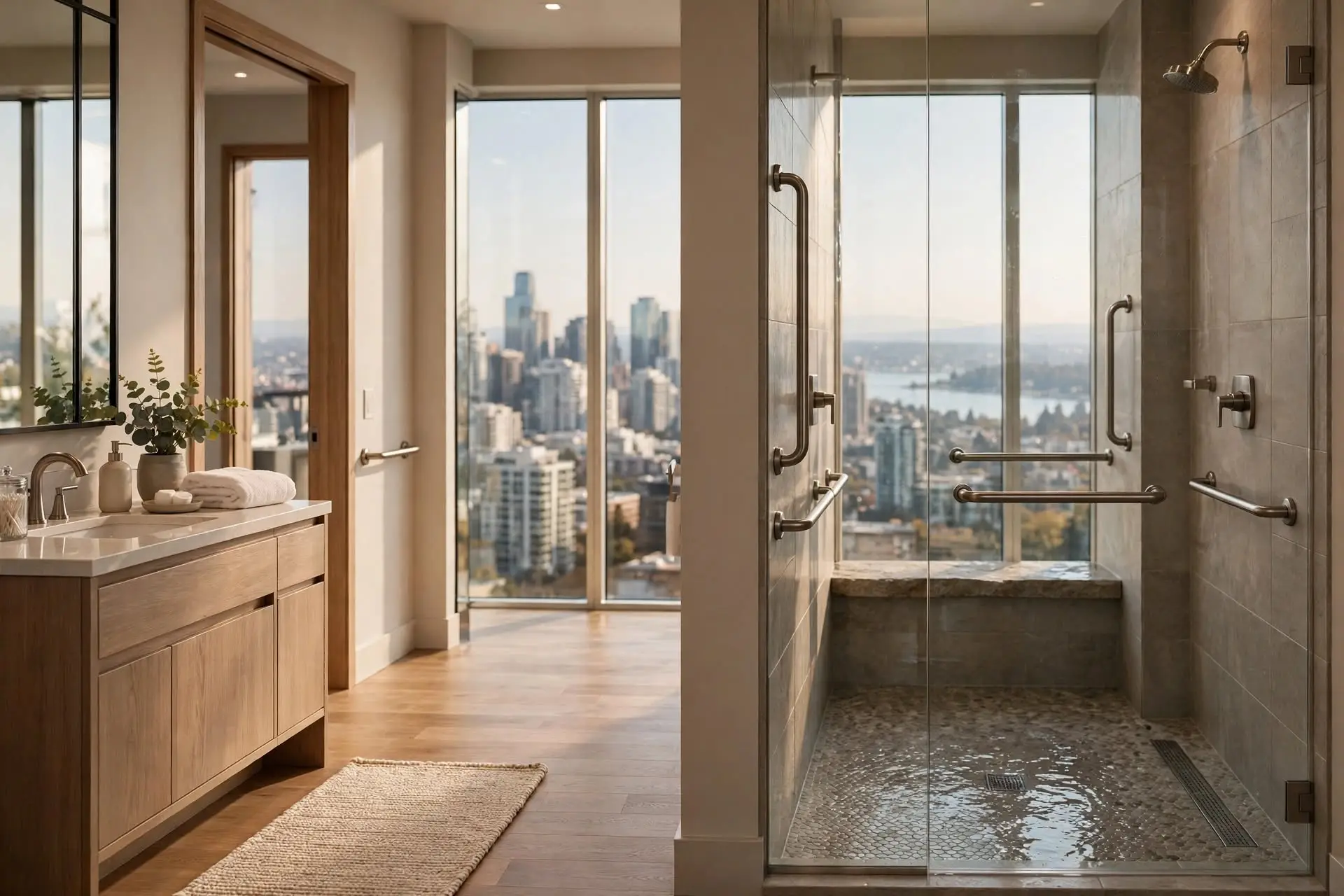
Bellevue has changed a lot over the last 20 years, and the housing has changed along with it. A big share of seniors in the area no longer live in the ranch homes and split-levels of the 1970s and 1980s. They live in downtown high-rises, in Bel-Red townhomes, and in newer condo developments along Main Street and 108th. Each of those housing types comes with its own bathroom safety picture, and the fixes that work for a rambler in West Bellevue do not always work for a fifteenth-floor condo above The Bravern. This is a practical look at what to think about in each type of unit.
High-Rise Condo Bathrooms
The downtown Bellevue high-rise market has grown steadily since the mid-2000s. Buildings like Two Lincoln Tower, Bellevue Towers, and Soma Towers house a significant number of residents over 65, many of whom moved from larger homes to simplify life. The bathrooms in these buildings tend to have specific characteristics that shape the safety work.
Concrete Slab Construction
Almost every high-rise bathroom sits on a concrete floor slab rather than wood framing. That matters for two reasons. Curbless shower conversions are much harder because the slab cannot be recessed the way wood floor joists can. The workaround is either raising the entire bathroom floor to meet a shallow shower threshold or using a recessed shower pan system that involves cutting into the slab, which most building associations restrict.
The concrete slab also affects grab bar installation. Bars still mount into the wall studs behind the tile, but the acoustical and fire code assemblies used in high-rise construction sometimes include metal studs rather than wood. Metal studs require different anchoring hardware and a slightly different install technique. A grab bar installer familiar with high-rise construction knows the difference and comes prepared with the right toggle anchors.
Building Rules & HOA Approval
Almost every Bellevue high-rise has a homeowners association with rules about what work can be done inside the unit. Grab bar installation is almost always allowed without special approval because it does not affect anything outside the unit. Larger changes such as tile work, plumbing modifications, or shower door removal usually need written approval from the HOA and sometimes from the building’s engineering consultant.
The typical HOA approval process takes two to four weeks. For anyone planning a larger bathroom project in a Bellevue high-rise, submitting the paperwork before scheduling any contractor visits saves time and avoids rescheduling fees later.
Townhome Bathrooms
Bellevue townhomes cover a wide range of ages and layouts. The older townhome communities in Crossroads, Factoria, and Newport Hills date from the 1970s and 1980s. The newer developments in Bel-Red and along the light rail corridor date from the last ten years. The bathroom safety picture is different for each.
Older Townhomes
Older Bellevue townhomes often have small primary bathrooms with a standard tub-shower combo, a low toilet, and limited floor space. The tight footprint makes some safety modifications harder. There is often not enough clear floor space for a walker or a standard shower bench.
The right approach in these bathrooms is usually a strong tub grab bar setup rather than a full shower remodel. A vertical bar at the tub entry, a horizontal bar along the back wall, and a comfort-height toilet swap handle most of the daily fall risk without any structural work. Total cost usually runs $1,000 to $2,000 for a bathroom set up this way.
For seniors who genuinely cannot get in and out of a tub anymore, a tub-to-shower conversion becomes the next step. In an older townhome, that conversion runs $8,000 to $15,000 depending on the layout and how much plumbing has to be moved.
Newer Townhomes
Newer townhomes built in the last decade tend to have larger primary bathrooms, sometimes with a separate shower stall and tub. The shower stalls are often already curbless or nearly so, which makes them good candidates for aging in place with minimal modification.
The main safety work in a newer townhome is grab bar installation in the shower, at the toilet, and along the tub edge if a tub is still in use. Anti-slip floor treatment on the porcelain tile floor is the other high-value addition because the large-format tiles common in newer builds get slick when wet.
Downtown Condo Bathrooms
The condo market in Bellevue overlaps with the high-rise market but includes many mid-rise buildings as well. Condos in the six-to-twelve story range make up a large share of the downtown housing stock, and they have their own bathroom characteristics.
Bathroom Layouts
Mid-rise condo bathrooms tend to be either a compact three-piece bathroom with a tub-shower, a toilet, and a single vanity, or a larger primary bath with a separate shower and tub. The compact bathrooms are the most common in older condos and are where most safety work gets focused.
Grab bar installation in a compact condo bathroom follows the same pattern as in a townhome, with a vertical bar at the tub entry and a horizontal bar along the back wall. The tight space actually makes grab bar placement easier because the walls are close enough that reach distances are shorter.
Access for Installation
One thing that catches contractors off guard in Bellevue condo work is the access logistics. Most buildings require certificates of insurance filed with the management office at least 48 hours before any work starts. Some buildings require use of specific service elevators during specific hours. A few restrict all contractor work to weekdays between 9 a.m. and 4 p.m.
Anyone scheduling bathroom safety work in a Bellevue condo should ask the building management about these requirements before booking the installer. Good local installers already know the rules for the main buildings in downtown Bellevue and can handle the paperwork as part of the job.
What to Do First
For any Bellevue senior in a condo, townhome, or high-rise thinking about bathroom safety, the first step is the same. Walk the bathroom with an honest set of eyes and note where the fall risks are.
Look at how you enter the tub or shower. Look at how you stand up from the toilet. Look at what you grab when you feel unsteady. If the answer to any of those questions involves a towel bar, a soap dish, or the shower door frame, those items are all rated only for their intended use, not for supporting body weight. That is the starting point for the grab bar work.
For most Bellevue units, a full bathroom safety upgrade takes half a day and costs $1,000 to $2,500. The change in daily confidence begins the first time the new bars get used.